
Sector brief 06 of 08
Energy, Renewables & Industrials
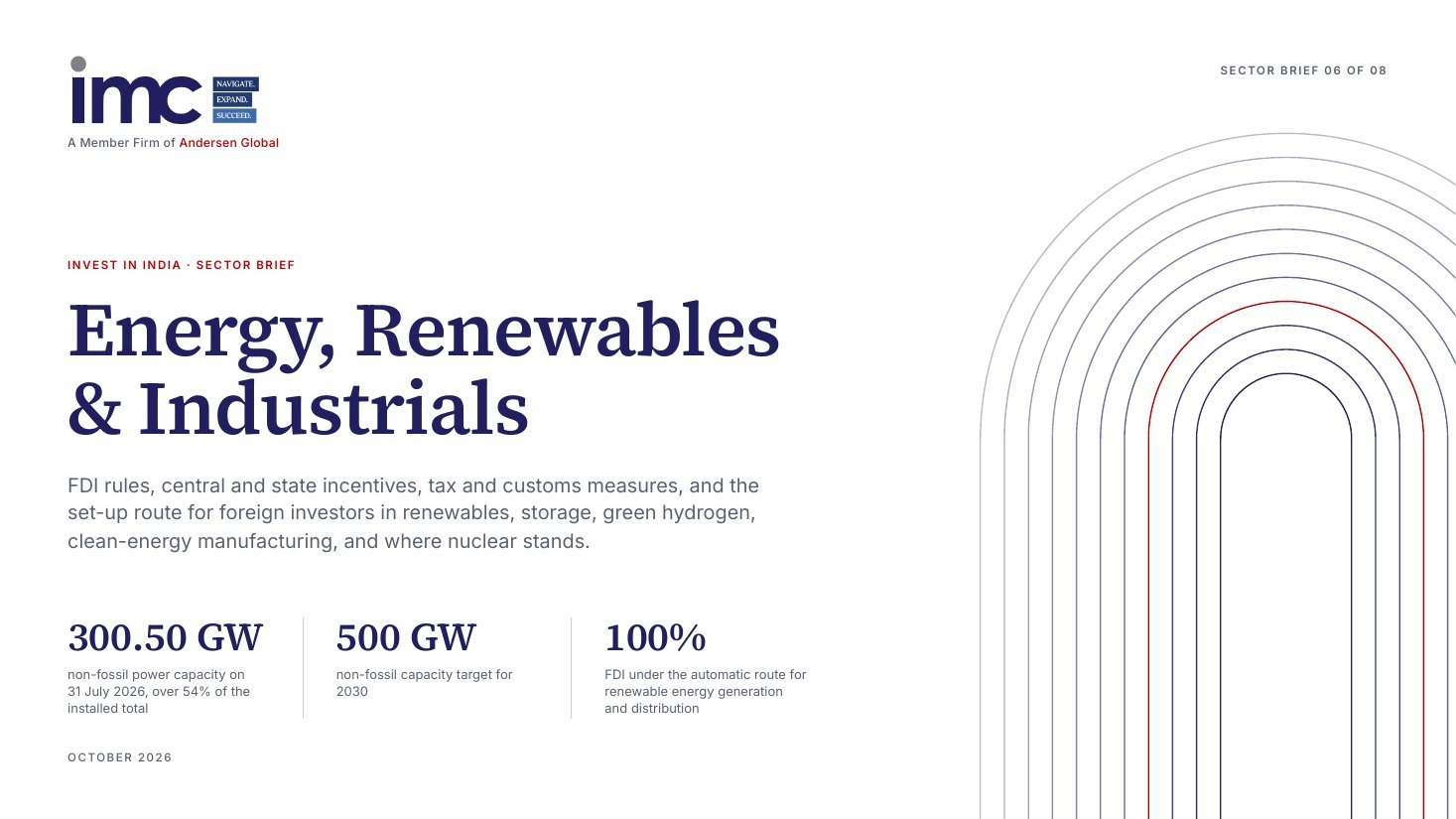
Renewable generation, transmission, oil and gas and most mining take 100% FDI on the automatic route; atomic energy stays closed to FDI. Tenders, grid access, power sale agreements and listed equipment decide whether a project gets built.
In this brief
Everything in this sector brief
11 pages, from the market case to the set-up roadmap and every incentive with its status.
Energy, renewables and industrials
Renewable generation, transmission, oil and gas and most mining take 100% FDI on the automatic route; atomic energy stays closed to FDI. Tenders, grid access, power sale agreements and listed equipment decide whether a project gets built.
ReadRecent foreign investments in Indian energy
Global infrastructure investors are building Indian renewable platforms. Five transactions announced between September 2024 and July 2026, with investor, home country, asset, size, date and the source that reported each.
ReadFDI rules for energy, renewables and mining
Renewables, oil and gas and mining allow 100% FDI on the automatic route; power exchanges and PSU refining are capped at 49%; atomic energy stays prohibited despite the SHANTI Act 2025. Investors from land-border countries need government approval above 10%.
ReadRegulators and registrations for energy projects
Projects need a tender award, grid access and listed equipment before supply. No standard timelines apply; timing depends on the tender schedule, land and grid availability. Seven approvals, who grants them and when each is needed.
ReadCentral incentives for energy and renewables
Manufacturing and hydrogen incentives are awarded in competitive rounds; storage, offshore wind and rooftop solar receive capital support; waivers, consumption mandates and new missions support offtake. Eighteen schemes with their printed status.
ReadState incentives for energy and clean-tech plants
States add duty waivers, land and capital subsidies to central support. Rajasthan and Uttar Pradesh rows come from clean-energy policies; Tamil Nadu, Maharashtra and Karnataka rows are general industrial policies, shown for equipment manufacturing.
ReadTax, customs and zones for energy investors
GST on clean-energy equipment fell to 5% from 22 September 2025 and Budget 2026-27 adds duty relief. The 15% regime is closed, so new generation and equipment companies typically pay 25.168%. ECB limits rose in February 2026.
ReadSet-up roadmap for energy projects
From entry decision to commercial operation of a utility-scale project: nine steps for a developer bidding in central or state tenders, how C&I and equipment projects differ, and the entity and incorporation steps that come first.
ReadWhat to watch in Indian energy projects
Grid access, contract signing and equipment rules drive most project risk. Six compliance watch-outs for renewable developers and equipment makers, with what each means for a bid or a plant.
ReadRecent changes in energy and renewables
What changed since 2025 for foreign investors in Indian renewables, storage, nuclear and offshore energy, with the date, the effect on investors and the source for each entry.
ReadSources for energy and renewables
The full reference list behind this hub, grouped as in the sector brief. Figures and statuses across these pages are as of 1 October 2026 and are quoted from the sources below.
ReadUpdates
Recent changes
- medium impact
- low impact
- high impact
Planning your move into India?
Talk to IMC about your entry structure, approvals, incentives, tax and the first year of compliance.